

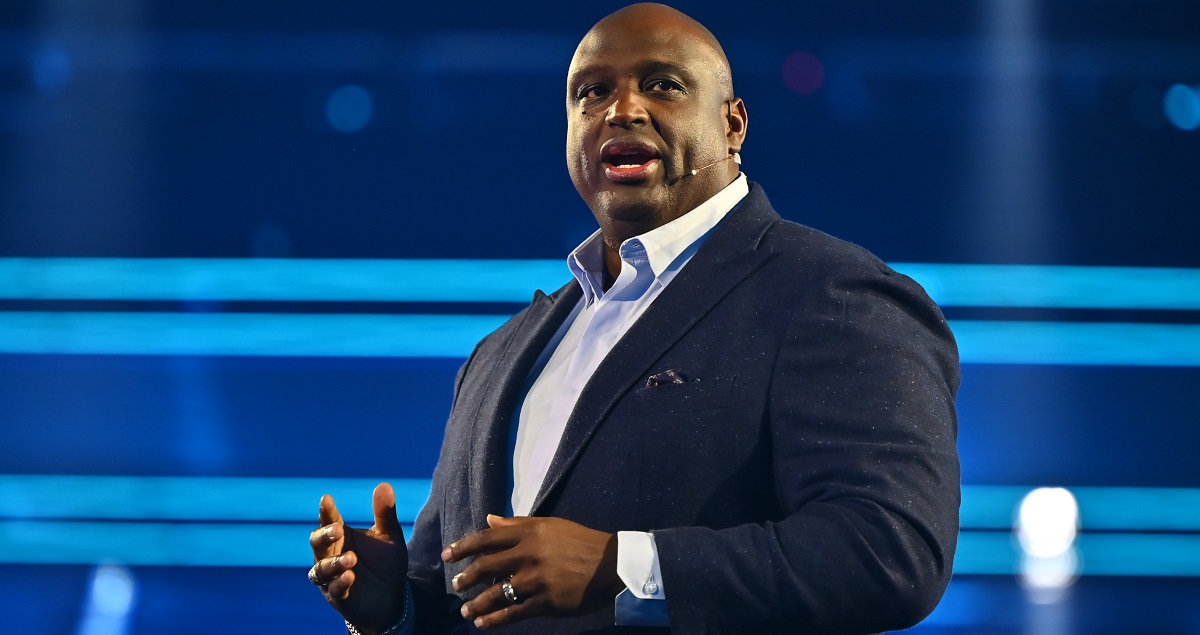
Rodney Bullard grew up in Decatur, Georgia, surrounded by two guiding forces: service and education. His father was a Baptist minister, his mother an educator, and together they helped shape a worldview centered on dignity, connection and collective responsibility. That foundation, strengthened by Bullard’s Air Force career and later his leadership roles in the corporate and nonprofit sectors, ultimately led him to create The Same House—an organization built to bridge social and economic divides by bringing people and institutions together.
Calling to Serve
Bullard’s path toward community-focused leadership took shape during his tenure at Chick-fil-A, where he developed and led the company’s Global Corporate Social Responsibility efforts. That work exposed him to the breadth of challenges facing families across the country and the power of cross-sector partnerships to address them. In 2019, he helped launch Atlanta’s first Beloved Benefit, an event designed to unite residents from every corner of the city around shared purpose. Four years later, that gathering evolved into The Same House, rooted in the ideals of Dr. Martin Luther King Jr.’s Beloved Community and the reminder from the late Congressman John Lewis that “we all live in the same house.”
Leadership Shaped
Bullard’s military service remains central to the way he leads. He recalls one moment at the Air Force Academy that completely reframed his understanding of leadership. Under the intense pressure of basic training, an upperclassman approached him and offered guidance without raising his voice. “He made it clear that the goal was growth, not intimidation,” Bullard said. The lesson was simple but enduring: leadership is not authority, but an investment in others’ potential. His later service in the Judge Advocate General Corps only deepened that conviction.
Another influence—what he calls the “three feet analogy,” shared by his friend Dr. Gregory Ellison—shapes The Same House today. “You may not be able to change the world in a single act,” Bullard said, “but you can always impact the people within your three-foot radius.” The organization builds on that belief, empowering leaders at every level to use their influence responsibly and collaboratively.
The challenges Bullard encountered transitioning from military service into public and nonprofit leadership were significant. The military provides clarity—defined roles, unified missions, established structure. Outside of that environment, influence must be earned through trust and shared purpose. Navigating the different languages and timelines of government, philanthropy, community groups and private industry required patience and adaptability.
Bullard met that complexity by listening first, leaning on the discipline learned in uniform and prioritizing relationships that strengthened long-term collaboration.
Closing Gaps
The urgency of The Same House’s mission is evident in the statistics Bullard cites about Atlanta, a city rich in innovation and history but also home to stark inequities. A child born into poverty there has only a 4% chance of escaping it. Life expectancy can differ by 20 years between neighborhoods. Income gaps continue to widen. Through initiatives like the Beloved Benefit, which has raised more than $33 million for local organizations, the organization directs resources to the communities most affected by these divides.
Yet Bullard emphasizes that the challenges extend far beyond Atlanta. “Where you start is more often than not where you end up,” he said. The Same House aims to change that reality nationwide.
Part of that work includes developing young leaders. The organization’s Youth LEAD Georgia program brought together 28 students from 28 counties for a year of hands-on leadership training, statewide travel and service learning. Graduates can apply for Bullard Community Champion grants to launch service projects in their hometowns—an investment in community leadership that grows from within.
National Vision
As The Same House expands, Bullard envisions a national network that strengthens mobility, improves alignment across sectors and gives communities a common platform for partnership. “Our goal,” he said, “is to remove silos and help communities access the relationships and shared infrastructure they need to thrive.”
For veterans seeking purpose beyond their military careers, Bullard’s message is simple: start with the skills you already have and connect them to a mission you believe in. Service, he said, doesn’t end with a uniform. It simply takes on a new shape—one built, fittingly, for the same house we all share.
Read more articles for the Veteran community here.