


By Bailey Fletcher
For many service members, the idea of earning a college degree while actively serving can seem daunting. With deployments, shifting schedules and the demands of military life, pursuing higher education might feel out of reach. But the truth is, thousands of service members and veterans earn degrees every year—thanks in large part to military-friendly colleges built to support them.
The data backs up why this matters. According to 2024 employment figures from the Bureau of Labor Statistics (BLS), veterans who hold a bachelor’s degree or higher enjoy a 53.3% employment rate, which is significantly higher than the 18.6% for those without a high school diploma. Education is a powerful tool for both job stability and long-term career success, especially for service members transitioning into civilian life.
In this guide, we’ll show how going to college while in the military is not only possible but increasingly practical.
The Military Pays for College?
While college is a major investment, service members and their families have access to extensive education benefits, from Tuition Assistance to the GI Bill that make degrees more affordable.
Tuition help is extensive: active-duty members can receive up to $4,500 annually through Tuition Assistance, which is approved for 87% of GI Bill recipients. Meanwhile, the Post-9/11 GI Bill and Yellow Ribbon Program offer even broader coverage for both public and private schools.
According to recent BLS data, nearly all veterans have earned at least a high school diploma, and about two-thirds have pursued some form of postsecondary education.
You can also fast-track your educational progress and earn college credit by exam through CLEP (College-Level Examination Program) and DSST (DANTES Subject Standardized Tests). These are standardized tests that allow you to demonstrate your knowledge in subjects like math, history or business, without taking the actual course. If you pass, you earn college credits that count toward your degree, potentially saving time and tuition. Both exams are widely accepted by colleges and are often free for active-duty military members through DANTES (Defense Activity for Non-Traditional Education Support).
A College Success Story
Many service members have successfully earned degrees while on active duty, using their education to transition into fulfilling post-military careers. Here’s some advice from a Commander who was successful:
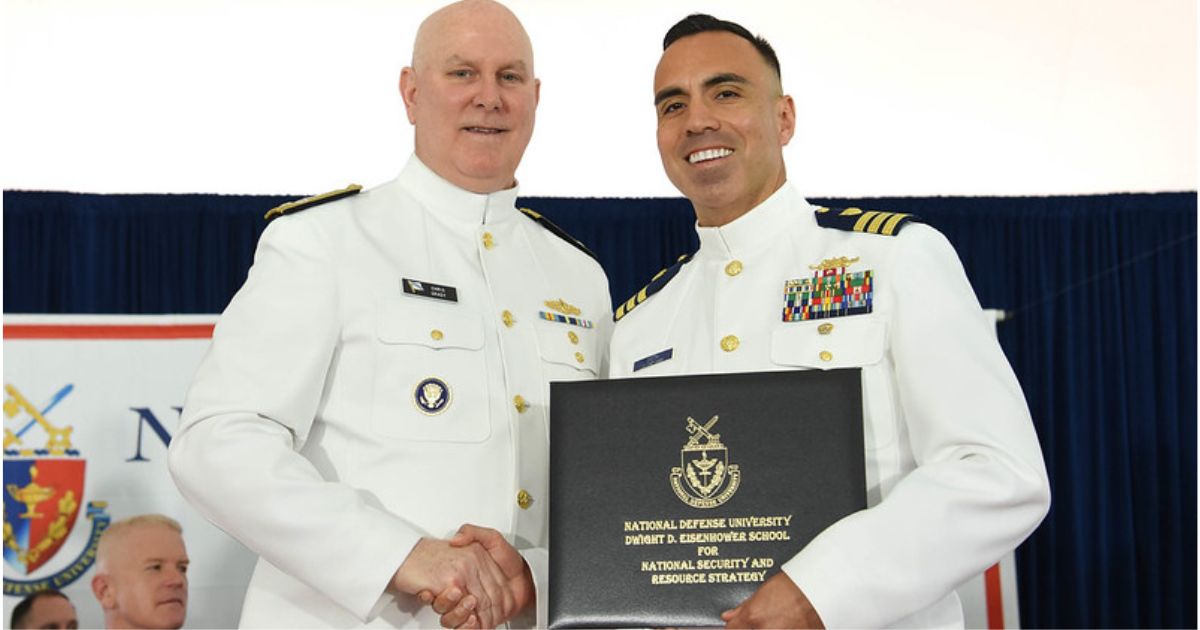
U.S. Coast Guard Commander David Smith has over almost two decades of leadership experience in maritime operations, strategic planning and interagency coordination. He has served in key roles across the globe, including as Commanding Officer in the Arabian Gulf and Liaison Officer to the U.S. Navy’s Third Fleet. Smith holds a master’s degree in national security and resource strategy from the Eisenhower School at National Defense University, as well as a master of public administration from Roger Williams University.
What challenges did you face while earning a degree in the military?
David Smith (DS): I began my Master of Public Administration while serving as a Lieutenant stationed on the Great Lakes. At the time, I was assigned to a demanding schedule with 12 hours on and 12 hours off. I initially enrolled in two courses per semester, but I quickly learned that this pace was too aggressive given the requirements of my military role. I scaled back to one course per semester.
My academic journey was further delayed when I became the Commanding Officer of a patrol boat in Bahrain. During this assignment, I had to temporarily pause my studies.
Although the program took eight years to complete, the slower pace gave me time to reflect on what I was learning and to apply it directly to my career in the Coast Guard. That deeper level of engagement made the experience worthwhile.
What are the best strategies for maximizing military education benefits?
DS: The first step is to understand the demands of your job and how they align with your academic program. Communicating clearly and early with your supervisors is essential. Your schoolwork should never interfere with your duties, but with honest communication, many leaders are supportive of academic goals.
It is also important not to rush. There is often pressure to complete a degree quickly, but doing so can lead to burnout or reduced performance.
What advice would you give to active-duty service members considering college?
DS: Start by identifying your purpose. Ask yourself why you want to pursue this degree. Whether it is for promotion, personal growth or creating more opportunities for your family, having a clear purpose helps sustain motivation.
Once you have defined your goals and research programs, commit to a schedule and find a mentor who can support you through the process. Establishing a routine will turn your studies into a consistent habit, which is essential for long-term success in any endeavor.
If you could do it again, what would you do differently?
DS: If I had the chance to do it again, I would be more patient with the process and myself. I placed too much pressure on myself to finish quickly, which added unnecessary stress. Looking back, the most important thing was completing the degree. I am proud that I stayed committed and finished, even if it took longer than expected.
Final Thoughts
For many veterans, a college degree is a powerful stepping-stone to long-term career success. According to a 2024 BLS report, veterans are more likely than nonveterans to hold management and professional positions, especially those with a bachelor’s degree or higher. Many employers value veterans’ leadership skills and problem-solving experience.

Military-friendly schools and organizations like Hiring Our Heroes and VA’s Veteran Readiness and Employment (VR&E) program help smooth the transition with job placement support, résumé workshops and networking opportunities.
With the right education and support, veterans can turn their military experience into a strong foundation for high-demand, well-paying civilian careers.
Bailey Fletcher is a senior editor at OnlineU, where she writes and edits higher education resources. Her work helps prospective students navigate online college options. For more information, visit onlineu.com. Photo Courtesy of ONLINEEU
Read more articles for the Veteran Community here.