

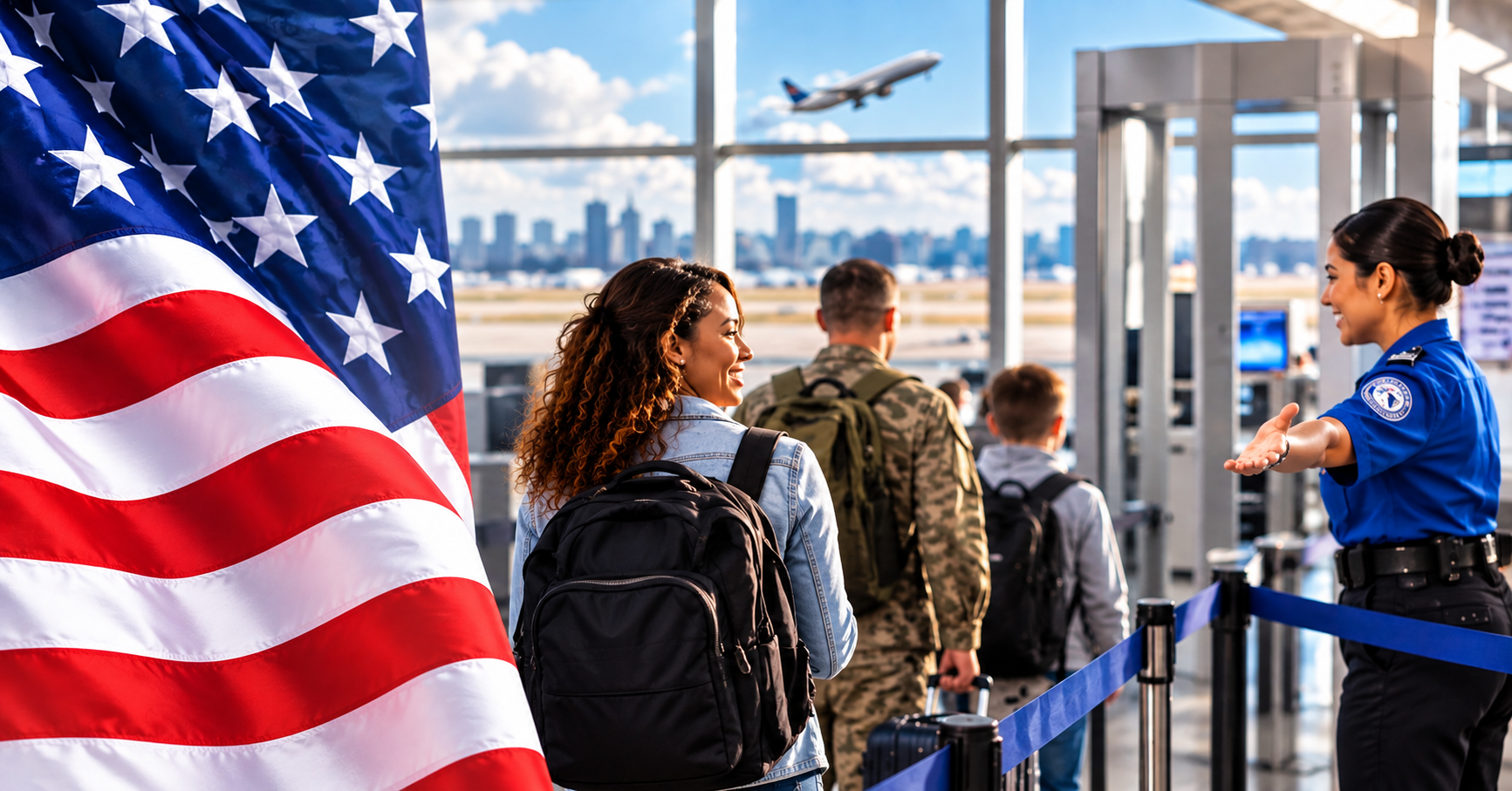
Anyone who has traveled through a busy airport knows that getting through security can sometimes be one of the most stressful parts of the trip. For veterans, service members and military families, a growing TSA initiative is designed to make that experience a little easier.
The Transportation Security Administration now provides dedicated military security lanes or front-of-the-line service at more than 30 airports across the United States, with recent reporting putting the number at 34. The benefit extends beyond active-duty service members to include veterans and their families.
It’s part of TSA’s broader effort to recognize the military community and improve the airport screening experience.
How Do the Military Lanes Work?
The concept is refreshingly straightforward.
At airports with a dedicated military lane—sometimes referred to as an Honor Lane—eligible travelers can present valid military or veteran identification to access the designated line. You don’t have to be traveling in uniform.
And there’s another benefit worth knowing about: TSA says that at airports without a dedicated military lane, veterans and military members can show a valid military or veteran ID to the lane monitor for front-of-the-line service.
The program does not mean travelers bypass security screening. Military lanes are designed to streamline access to the checkpoint; travelers still complete the security screening required for their assigned lane.
What Identification Can Veterans Use?
Veterans should make sure they have the appropriate identification before heading to the airport.
According to TSA guidance, a Veteran Health Identification Card (VHIC), DoD Uniformed Services ID Card (USID), or state-issued veteran driver’s license/state ID can establish veteran status and serve as acceptable identification.
Other documents—including a Veteran ID Card (VIC), VA Proof of Service Letter or state/county veteran ID card—can establish veteran status, but TSA says they must be presented along with another acceptable form of identification.
Where Can Veterans Find Military Lanes?
TSA’s current published list includes airports across the country, from major hubs to regional airports. Among them are Los Angeles International (LAX), Hartsfield-Jackson Atlanta (ATL), Denver International (DEN), Miami International (MIA), Fort Lauderdale-Hollywood International (FLL), Harry Reid International in Las Vegas (LAS), Phoenix Sky Harbor (PHX), San Diego International (SAN), Seattle-Tacoma International (SEA), Nashville International (BNA) and Charlotte Douglas International (CLT).
TSA’s published list also includes airports in Albuquerque, Albany, Austin, Birmingham, Boise, Cleveland, Columbus, Detroit, El Paso, Honolulu, Raleigh-Durham, San Antonio, Tampa, Anchorage and several other cities. Because airport participation can change, travelers should check TSA’s current information before leaving for the airport.
Check TSA’s current Military Lanes information and participating airports
Don’t Confuse Military Lanes With TSA PreCheck
There is an important distinction between a military or Honor Lane and TSA PreCheck.
Using a military lane doesn’t automatically give every veteran TSA PreCheck status. Active-duty service members can receive TSA PreCheck benefits at no cost by entering their DoD identification number as their Known Traveler Number when making a reservation.
There is also a separate benefit for certain disabled veterans. Under the VETS Safe Travel Act, veterans enrolled in VA health care who meet specific service-connected disability requirements can qualify for free TSA PreCheck enrollment and renewal.
A Small Benefit That Could Make a Big Difference
For veterans who travel frequently—or anyone who has found themselves staring at a long security line while wondering whether they’ll make their flight—this is a benefit worth remembering.
It’s also easy to overlook. There isn’t necessarily a military lane at every airport, and the signs and procedures may differ depending on the location. Knowing about the benefit before traveling can make all the difference.
So, the next time you’re headed to the airport, bring your appropriate veteran or military identification and look for a Military or Honor Lane—or ask a TSA officer about military and veteran screening options.
After years of navigating deployments, duty stations and military travel, getting through one more line a little faster may be a welcome benefit.
Read more articles for the Veteran Community here.