

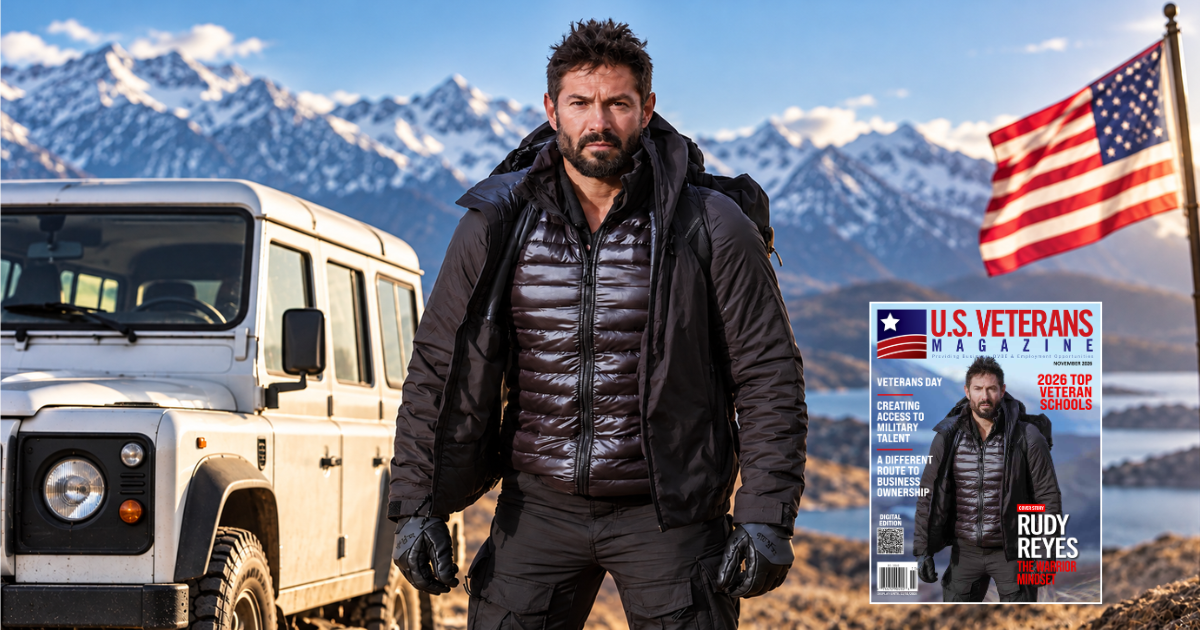
Long before Rudy Reyes became a reconnaissance Marine, combat diver, television personality or conservationist, he was a kid trying to understand where he belonged.
His childhood was unstable. Reyes and his two younger brothers eventually landed at the Omaha Home for Boys, where life suddenly had things that had often been missing: regular meals, medical care, responsibilities and structure.
And a wrestling mat.
“I got a wrestling mat. I got a weight pile,” Reyes recalled.
The home was run in part by house parents who were veterans of World War II, Korea and Vietnam. Military influence was already familiar. Rudy Reyes Sr., the man who raised him and whom Reyes considered his father, had served as a Marine in Vietnam.
“He was my very first hero I ever had,” Reyes said.
As a child, Reyes studied a photograph of his father in dress blues, once carefully recreating it with crayons and making sure he got the buttons right.
At the boys’ home, wrestling gave his competitive drive somewhere to go. Tournaments also exposed him to families who showed up to cheer for their children—a revelation for a boy accustomed to handling much of life himself.
Years later, sport, physical challenge and the examples set by veterans around him would converge.
Called to Serve
 Courtesy of Rudy Reyes
Reyes joined the Marine Corps as an infantryman as conflict unfolded in Kosovo. He describes the decision not as a quest to prove his toughness, but as an obligation.
VIEW, ENJOY & SHARE THE DIGITAL MAGAZINE—FEATURING OUR EXCLUSIVE COVER STORY!
“It was the ethics of sport and the ethics of martial art,” he said. “If another strong young man is going to go fight, then I must do my part.”
He became an Iron Man and honor graduate at the School of Infantry before earning the chance to try out for reconnaissance. That opened the door to years of specialized training, including combat diving, parachuting, scout sniping and demolitions.
Reyes served two enlistments over seven years. He was still a junior Marine in his reconnaissance platoon when terrorists attacked the United States on Sept. 11, 2001.
Everything changed.
The years that followed brought sustained combat, including operations in Iraq, Fallujah and Ramadi. Eventually, Reyes said, what those years required of him began affecting who he was away from the battlefield.
“I had been in so much war for so long that it was emotionally and spiritually starting to affect me,” he said. “I had become very cold and very hard because that’s what it takes.”
Coming Home
 Courtesy of Rudy Reyes
Leaving the Marines did not make that hardness disappear.
Reyes threw himself into work, teaching fitness and kickboxing and continuing to train in martial arts. Then HBO came calling about Generation Kill, the miniseries based on the Marine unit Reyes had served with during the invasion of Iraq.
Originally brought aboard to help train actors and impart Marine culture, Reyes ultimately portrayed himself.
“I felt connected again,” he said.
Production had qualities he understood: long hours, teamwork, pressure, changing conditions and the constant need to adapt. But when a project ended, the structure disappeared with it.
Reyes began drinking heavily and using drugs. He described becoming increasingly violent and self-destructive as he moved between entertainment work and government contracting. Some stretches of those years remain difficult for him to remember.
Eventually, he entered Veterans Village of San Diego and stayed for a year.
“I didn’t want to be on the run and run away anymore from what was killing me,” Reyes said.
There was no single moment that fixed everything. But throughout the turmoil, Reyes says one constant remained.
He kept training.
Physical Grounding
 Courtesy of Rudy Reyes
“Physical fitness and martial art is still my bedrock to this day,” Reyes said.
For him, training is about more than conditioning. It means deliberately entering a place of pain, fear, exhaustion and limitation—and discovering what remains when everything else gets quiet.
“When you’re breathing so hard and your body is burning, you can only think of one thing at a time,” he said.
That singular focus connected the wrestler he had been as a boy with the reconnaissance Marine, combat veteran and man trying to establish a life afterward.
“There’s no shortcuts, and you truly are doing something honest for yourself,” Reyes said. “The only way to improve is to endure.”
Today, television audiences see that philosophy put into practice. Reyes serves as directing staff and chief instructor on Special Forces: World’s Toughest Test and has also worked on the British series SAS: Who Dares Wins.
But another mission gave his military skills an entirely different outlet.
Underwater Mission
 Courtesy of Rudy Reyes
Reyes had been trained as a combat diver, where entering the water meant operating under extreme conditions. Years later, he went diving recreationally.
This time, there was daylight. Marine life. Coral reefs.
And Reyes saw something worth protecting.
Learning about threats to the reefs reminded him of communities he had fought to protect overseas. He began wondering whether the highly specialized abilities developed for warfare could be redirected toward conservation.
“I said, ‘Well, I’ve got to do something about this,’” he recalled.
That idea helped lead to Force Blue, which Reyes co-founded to bring former special operations veterans together with marine scientists and conservation professionals. Its teams apply their skills to work including coral reef restoration and ocean conservation.
Reyes said the mission “brought me back to life.”
A decade later, he said Force Blue includes more than 60 operators. Skills once developed for combat had found another application—and veterans accustomed to working as part of highly capable teams had another mission.
Still Moving
Reyes’ entertainment career has accelerated as well. In addition to Special Forces and SAS: Who Dares Wins, he has appeared in military and survival programming and continues working behind the scenes with productions.
Yet the story Reyes most wants other veterans to see is not one of television success.
It is what came before it.
The boy who learned to fight for his place. The Marine shaped by years of combat. The veteran who struggled after coming home. The man who eventually redirected skills developed for war toward protecting something entirely different.
“We can prevail,” Reyes said. “We can prevail.”
Something Larger
 Courtesy of Rudy Reyes
For Reyes, those words carry particular weight as Veterans Day approaches.
“It’s an honor to be among the men and women that have served our country from its inception,” he said.
Military service gave Reyes skills he continues to draw upon professionally and as a father. It also taught him that committing yourself to something larger can change what you believe you are capable of doing.
“That’s what veterans do,” Reyes said. “They put themselves to the side to serve something so much larger.”
Reyes typically marks Veterans Day among fellow veterans. This year, he expects to spend it teaching and training alongside other warriors.
He hopes Americans remember that the freedoms surrounding their everyday lives were protected by generations of people willing to stand between their country and danger.
“I think it’s really important for everyone in the country to remember that without the men and women holding that line, that we would not have any of this,” Reyes said. “We’re blessed to be American.”
For all the intensity of Reyes’ life, the philosophy he carries into each morning is remarkably simple. He uses it when professional commitments pile up. He uses it while juggling production meetings and raising two teenagers. And it echoes the message he hopes his own life can offer other veterans.
“Rudy Reyes, believe in yourself always.”
Read more inspiring articles for the veteran community here.