

By Kellie Speed
Retired U.S. Army Sgt. Adam Hartswick knows just how quickly first responders need to react when dealing with trauma, especially when it comes to a life-or-death situation.
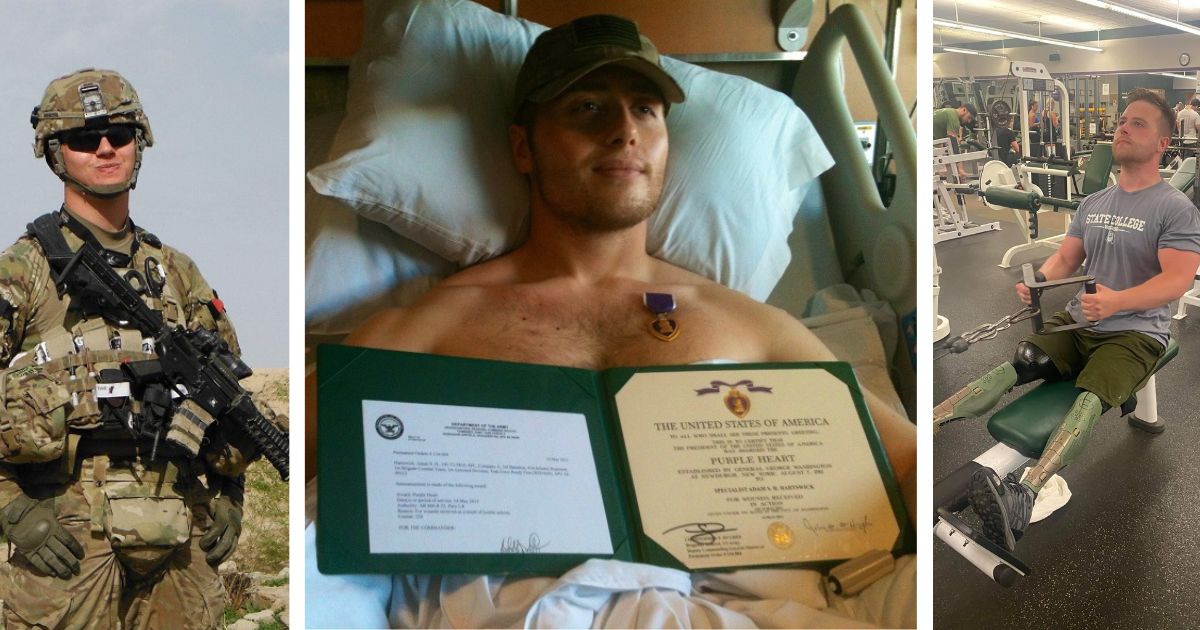
The former combat medic, who lost both of his legs while serving in Afghanistan’s Kandahar Province, would not be here if it weren’t for the life-saving techniques he and his fellow Soldiers implemented that fateful day when he also lost four of his brothers in arms—SFC Jeffrey C. Baker, SPC Mitchell K. Daehling, SPC William J. Gilbert and SPC Cody J. Towse.
“I was on my second deployment and had been in for three years at that point,” Hartswick told us in a recent phone interview. “I was a senior medic at 22 years old. I like to say that I was an ignorant kid put in a leadership position. We were very shorthanded, so I wore different hats that deployment.”
On May 14, 2013, Hartswick was in the guard tower and received a call that the second platoon was being ambushed. “I grabbed my medic kit and told my commander I needed to go out,” he said. “He didn’t have a chance to argue. I showed up on scene and we unloaded our trucks and moved out to the X where the ambush took place.”
Unaware of the extent of injuries, Hartswick said he was looking for Towse.
“We had lost three guys at that point,” the 34-year-old said. “I took a tactical pause. Towse was gone. Then the EOD team showed up and they were incredible. Jeff went to clear a path for human remains recovery when another device went off next to him. I treated another wounded Soldier from the blast that killed Jeff and then went back for Jeff and stepped on one myself.”
During the blast, Hartswick sustained a traumatic brain injury, perforated his ear drums, lost an index finger and part of his thumb, and both legs were amputated above the knees. Thanks to his quick thinking and military training, he applied his own tourniquet before being evacuated by a medevac helicopter.
“Two helmet cameras were on the crew who medevac’d me, so I have gotten to see the explosion happen and then get loaded onto the bird missing my legs,” he said. “I can see me say, ‘morphine,’ but I didn’t feel any pain then, but I knew I would.”
After a six-day journey from the X to Walter Reed National Military Medical Center in Bethesda, Maryland where he received the Combat Medical Badge, Purple Heart and Army Commendation Medal for Valor, he would be on a long, two-year road to recovery.
Today, the Pennsylvania resident has found a new calling teaching a tactical combat casualty care course to first responders.
“I feel as though I have a duty now to train combat lifesaving skills,” he said. “I believe there is a difference between being harmless and peaceful. I know the cost of violence and choose to be peaceful. I also believe in brilliance and basics. You have to master the basics. For example, to put on a tourniquet, the standard time is 30 seconds. I can do it in 15 seconds and know a high school kid who can do it in 11 seconds.”
Earlier this year, Hartswick was an honoree at Boston’s Wounded Vet Run.
“Boston was an unbelievable experience,” he said. “To stand alongside previous honorees and the heroes of Abbey Gate was somber, humbling and incredible. I was there at the beginning of the war, and they were there at the end.”
Read more articles for the Veteran Community here.