


By Lori L. Tyler
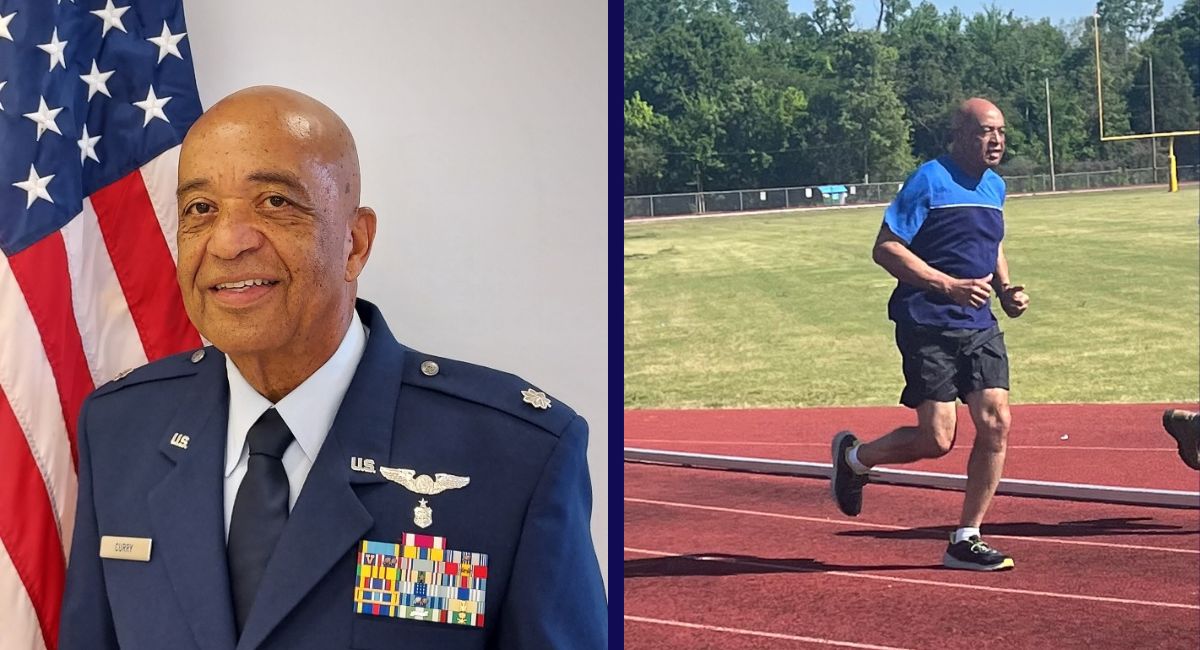
The sun has barely begun its ascent, casting long shadows across the pavement, but Herman Curry is already in motion. His steady breath paces his stride as he clocks another mile, one of 10 he’ll complete before the day is done. At 76, most people have slowed down. Not Curry. He has spent a lifetime outrunning obstacles, and he doesn’t plan to stop now.
Service Legacy
Born in Ferriday, Louisiana, on November 10, 1949, Curry’s life has been defined by an unyielding commitment to discipline, resilience and service. In the 11th grade, his family relocated to Detroit, a city where he would later make history. Despite the decades spent away, he returned to Ferriday in 2019, bringing his passion for mentorship and fitness back home.
Service runs deep in Curry’s family. His two younger brothers also answered the call: one served in the Army, the other in the Marine Corps. Curry chose a different path by enlisting in the Air Force, where he served for 38 years and rose to the rank of colonel. But his leadership extended beyond the military. After retiring, he transitioned into law enforcement and eventually became the deputy chief of police for the city of Detroit.
Making History
It was during his time in law enforcement that Curry cemented his place in history. In the early 1980s, Detroit recognized the need for a specialized tactical team, and Curry was sent to Israel for training. There, he worked with one of the world’s most elite counterterrorism forces. This was the same unit responsible for the 1972 Munich Olympics hostage rescue, although not the same individuals. The training was brutal. Live ammunition drills, high-stakes combat scenarios and relentless physical demands pushed him to his limits.
“It was some of the most intense training I’ve ever experienced,” Curry recalls. “But I knew if I could push through that, I could push through anything.”
When he returned to Detroit, he applied what he had learned and built the city’s first SWAT team, making history as the leader of the first certified SWAT unit in the United States. His endurance as a runner became a valuable asset. Each SWAT trainee had to complete a three-mile run in 18 minutes or less to earn international certification. Curry, a lifelong runner, led from the front.
“I never asked my team to do something I wouldn’t do myself,” he said.
Mentorship Mission
After years of commanding high-stakes operations, Curry found a new calling in the classroom. As a JROTC instructor at Natchez High School in Mississippi, he discovered his next mission: shaping the next generation of leaders. His lessons go beyond textbooks and drills. He teaches grit, perseverance and self-discipline.
Curry doesn’t just teach discipline, he lives it. His daily routine reflects his unwavering commitment. Each morning begins at 5 a.m. with a one-mile warm-up run. Throughout the school day, he runs two miles with each of his four JROTC classes. By the time he completes his evening run, he has logged nearly 10 miles. Even a recent knee injury sustained at a school football game, which temporarily cut his mileage to six, hasn’t slowed him down.
“I’ll be back to 10 miles soon,” he said, without hesitation.
Unexpected Diagnosis
Despite a lifetime of physical fitness, Curry received an unexpected diagnosis several years ago: Type 2 diabetes. The news came as a shock. Often associated with obesity and a sedentary lifestyle, diabetes seemed an unlikely adversary for someone as active as Curry. Yet his experience serves as a powerful reminder that diabetes does not discriminate.
His first warning sign was neuropathy in his feet, a painful and often debilitating condition. At night, he lay awake, tormented by a burning sensation that made sleep nearly impossible.
“It felt like dead weight,” he says. “Like my feet were on fire.”
The pain threatened to derail his lifelong commitment to running. But Curry refused to give in.
Finding Relief
Curry sought treatment at Diabetes Relief of Louisiana, a specialized diabetes management program founded by cardiovascular surgeon Dr. Gary Jones in Alexandria, Louisiana. After beginning PIR infusion therapy, he noticed an immediate improvement.
“There was a time when I couldn’t sleep,” he says. “My feet felt like heavy weights, burning nonstop. I don’t have that anymore.”
Throughout his journey, Curry has had the steadfast support of his wife, Audrey, a registered nurse who plays a key role in managing his diabetes. Audrey ensures he maintains a proper diet, complementing his rigorous exercise routine. Together, they’ve raised two adult children, a son and a daughter, who have inherited their father’s dedication to discipline and perseverance.
Now, Curry uses his platform to advocate for health and wellness, especially for those at risk for diabetes.
“Start small,” he advises. “If you live a sedentary lifestyle, begin by walking from the kitchen to the living room several times a day. Then go outside on a nice day and walk to the corner and back. Gradually, you’ll build endurance. Before you know it, you could be walking a mile or more daily.”
Jones, who is also a veteran, said Curry is the embodiment of what veterans can accomplish post-service. “Mr. Curry’s life story is remarkable. He’s the kind of person who inspires everyone around him,” Jones says. “His story shows what’s possible when discipline meets determination. We’re proud to be a part of his journey.”
Life in Motion
For Curry, running is more than just exercise. It’s a way of life, a symbol of perseverance and a source of inspiration for everyone around him. Whether he’s in the classroom, on the track or out in the community, his influence is undeniable.
Ask Curry about retirement, and he just laughs. “I’ll stop when I can’t move anymore,” he said. “But until then, I’m not slowing down.”
Lori L. Tyler is a freelance journalist. Through The Heart of a Story, she writes about resilience, healing and the extraordinary strength found in everyday lives.
Photo credits: Lori L. Tyler
Read more articles for the Veteran Community here.